What is an AI Agent? How it differs from a chatbot and how businesses use it

AI Agents are becoming the most important automation layer for businesses in the AI era. But what exactly is an AI Agent, how does it differ from a chatbot, and how should a business get started? This article answers those questions concisely and practically.
An AI Agent is software that can perceive context, reason, make its own decisions and act to achieve a goal, while continuously learning. Unlike a fixed-script chatbot, an AI Agent proactively uses tools such as your CRM, APIs and chat channels to get real work done - advising customers, closing orders and providing support 24/7.
What is an AI Agent?
An AI Agent is a software system built on a large language model that can perceive context, reason, make its own decisions and act to achieve a specific goal, while learning from feedback. Instead of just answering questions, an AI Agent can proactively plan multi-step actions and use external tools - calling APIs, querying databases, updating a CRM or sending messages.
Put simply: if a chatbot is a call-center operator reading from a script, an AI Agent is more like a colleague who understands the job, handles things independently, and only escalates to a human when it truly needs to.

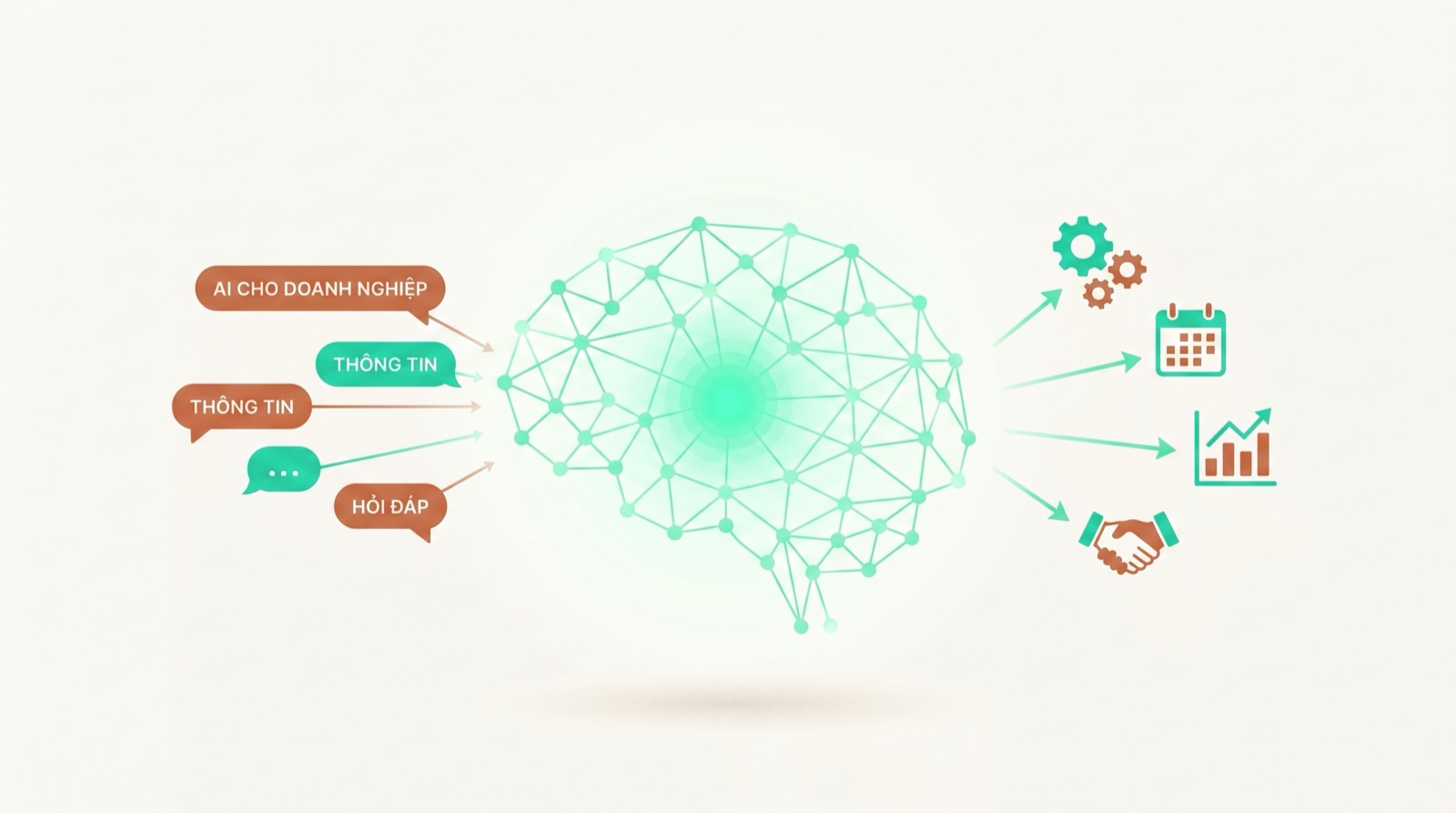
An AI agent connecting to messages, calendar and orders. Illustration. Illustration generated with AI.
How is an AI Agent different from a chatbot?
This is the most common point of confusion. Both can hold a conversation, but the capabilities behind them are fundamentally different.
| Criteria | Traditional chatbot | AI Agent |
|---|---|---|
| How it responds | Follows a script or fixed decision tree | Understands natural language, responds in context |
| Proactivity | Only answers when asked | Plans and acts in multiple steps on its own |
| Tool use | Limited or none | Calls APIs, CRM, inventory, sends messages |
| Learning | Requires manual reprogramming | Improves from data and feedback |
| Goal | Answer questions | Complete real tasks such as closing orders, booking appointments |
If you already run a scripted chatbot, you can upgrade to an AI Agent while keeping your existing channels - website chat, Messenger or messaging apps.
How does an AI Agent work?
Most AI Agents run on a four-step loop. Understanding this loop makes it clear why an Agent can get real work done instead of merely replying.
Perceive
Takes in messages, customer data, order history and context from connected channels.
Reason
Analyzes the customer's need, cross-references product knowledge and plans the right action.
Act
Advises, quotes, creates orders, books appointments, updates the CRM or hands off to a human when needed.
Learn
Records outcomes and feedback so the next interaction is more accurate and more natural.
You can see a more detailed walkthrough of how an AI Agent operates in practice on our AI Agent for business page.
What can an AI Agent do for your business?
The value of an AI Agent lies in absorbing repetitive tasks while raising the customer experience. According to Salesforce research, 82% of users choose a chatbot over waiting for a human when the question is simple[4]. Common applications:
- Sales: advises on products, makes tailored suggestions, quotes prices and closes orders right inside the chat.
- Customer support: answers FAQs, checks order status, handles returns - available 24/7.
- Internal operations: aggregates data, sends reminders, updates the CRM and generates reports.
- Omnichannel: keeps conversations in sync across your website, Messenger and messaging apps in one thread.
A practical roadmap for deploying an AI Agent
Don't try to build an AI Agent that does everything from day one. A sensible roadmap:
- Pick one clear goal, such as advising on and closing orders for one product line.
- Train it on your brand voice and your real product knowledge.
- Connect channels and tools - website chat, Messenger, messaging apps and your CRM.
- Run a pilot with a human in the loop, so people supervise and fine-tune the Agent.
- Measure and expand based on response rates, closed orders and customer satisfaction.
Stay realistic: Gartner predicts over 40% of agentic AI projects will be canceled before the end of 2027 due to escalating costs or unclear value[5]. The lesson is to start with a narrow scope and measurable goals, rather than expecting an AI Agent to do everything at once.
Why brand-specific training matters
A generic chatbot sounds like everyone else's. An AI Agent creates value when it is trained on your exact brand voice and products, speaks your customers' language naturally (including local phrasing and shorthand), and connects to the channels where your customers actually message you. This is also the phygital approach we follow at Chạm: unifying brand, physical space and AI Agent into one seamless journey. Read what phygital is to see the bigger picture.

A dedicated visual selected for this article. Photo: K3NMA, BY license.
Frequently asked questions about AI Agents
Will an AI Agent completely replace staff?
No. The AI Agent absorbs the repetitive work and covers 24/7, while people focus on complex situations and customer relationships. The most effective model is humans and AI working together.
Should small businesses use an AI Agent?
Yes. Small businesses benefit the most because they can respond quickly and around the clock without hiring more staff. Start with a narrow scope, then expand gradually.
How long does deployment take?
An AI Agent with a reasonable scope, trained on your products and brand voice and connected to your chat channels, typically takes a few days to a few weeks depending on complexity.
References
- HubSpot - Customer Service Statistics (90% of customers expect an immediate response).
- McKinsey & Company - The economic potential of generative AI (AI value of $2.6-4.4 trillion per year).
- Gartner - 40% of Enterprise Apps Will Feature Task-Specific AI Agents by 2026.
- Salesforce - Chatbot Statistics (64% value 24/7 availability; 82% choose a chatbot over waiting).
- Gartner - Over 40% of Agentic AI Projects Will Be Canceled by End of 2027.