ZNS templates: approval, pricing and common errors

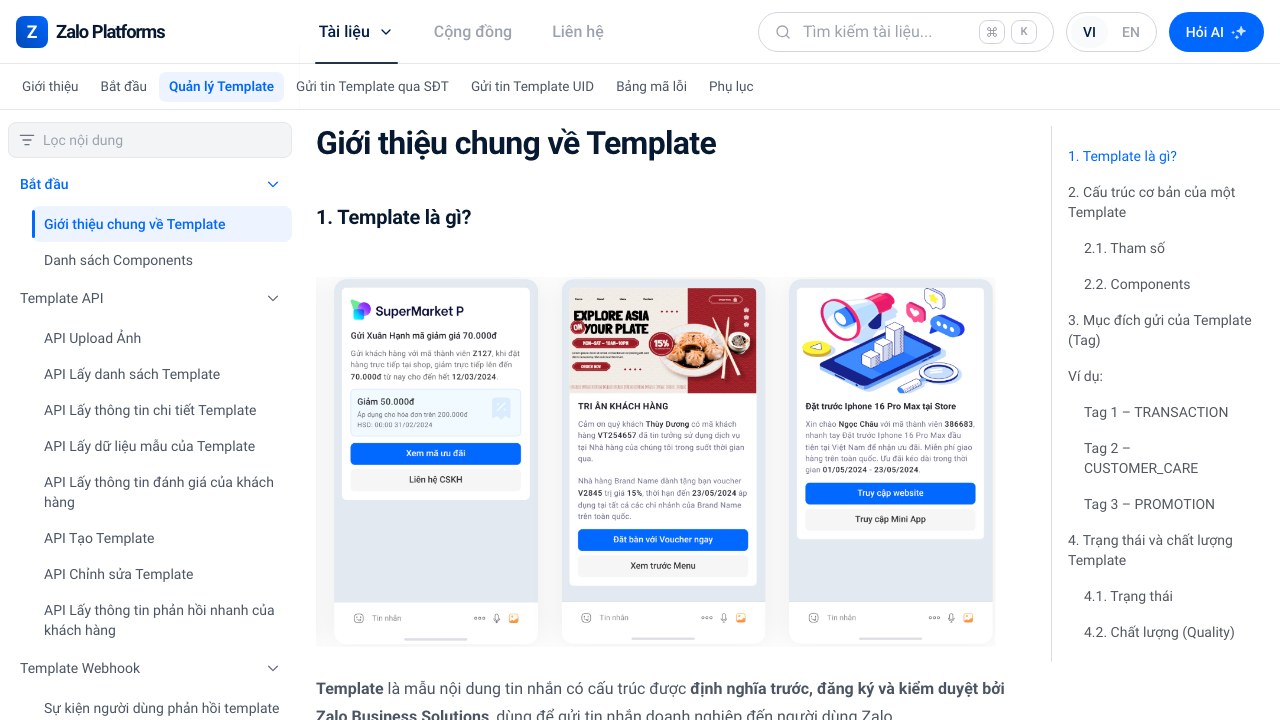
Screenshot of Zalo documentation captured on 23 October 2026. Source: Template overview. Official source.
An approved ZNS template does not guarantee that every message will reach its recipient. For an integration team, template review, channel pricing and send-request failures are separate problems with different evidence and owners.
ZNS is now part of ZBS Template Message. Prepare a template with the right purpose, confirm its approved status, and retrieve its phone or UID price. Review rejection comes with a template reason; API failures require checking the returned code, OA permissions, account configuration and request data.
How do ZNS templates relate to ZBS Template Message?
Zalo's launch announcement dates the consolidation of ZNS, UID Transaction and UID Communication into ZBS Template Message to 1 January 2026. ZNS remains a useful search term, but current instructions distinguish delivery by phone number from delivery by OA-specific user ID.
A template combines an approved presentation structure with dynamic parameters. An order notification might keep its explanatory text while receiving a customer's name and order code at send time. Treat those values as inputs to an agreed schema, rather than permission to replace the whole message with campaign copy.
What should a business prepare for template approval?
The API setup guide identifies an OA, an authorized Zalo App and a connected ZBS Account for paid features. Alongside those accounts, prepare the intended audience, the event that triggers the message and a clear example of the resulting content.
The review policy updated on 21 October 2026 requires suitable purpose classification and personalization. Put links and hotlines in the corresponding CTA, and avoid broken, shortened or unrelated destinations. An invitation to follow an OA belongs to Tag 3 rather than being appended to a Tag 1 or Tag 2 template.
The policy also requires a prior transaction with the business, with an exception for authentication during new-account creation. Possession of a phone number in a CRM is not, by itself, evidence that the person qualifies for every template category.
A useful submission note explains which business event creates the notification and how the recipient relates to that event. This is preparation advice, not a promise of approval. The service introduction gives an estimated review time of two to three working days. Plan a review stage before assigning a launch date to the integration.
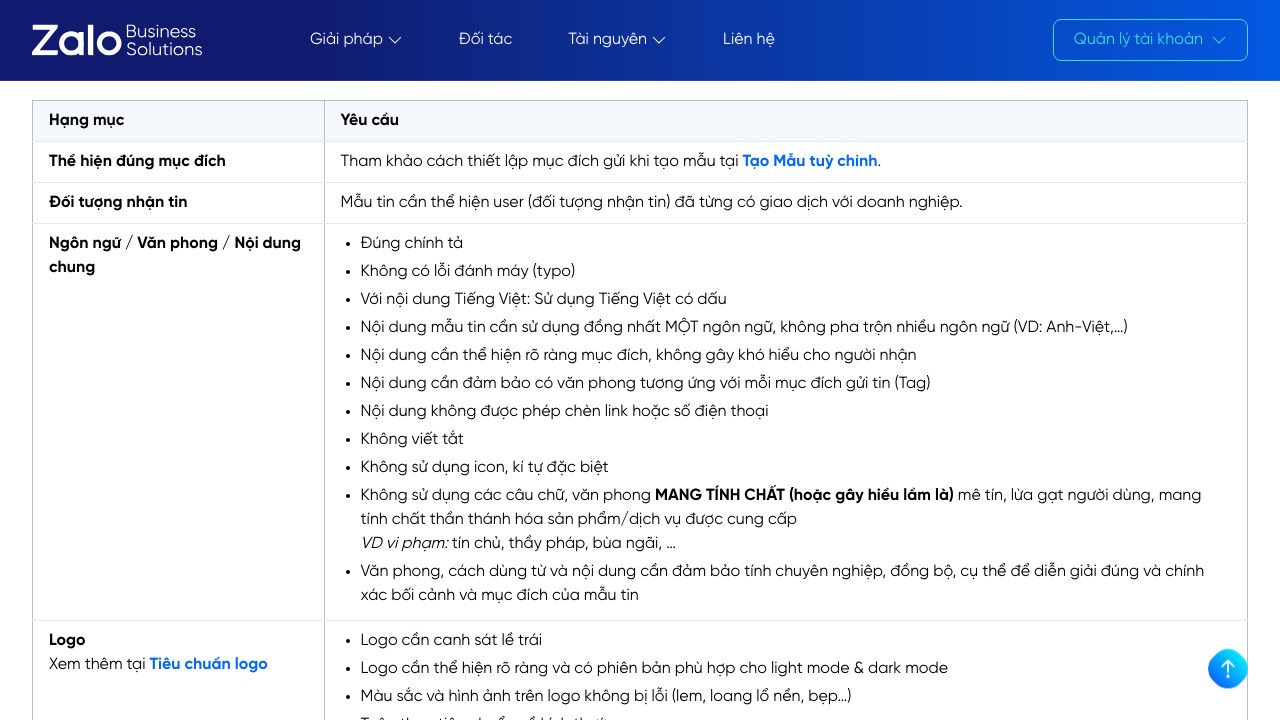
Screenshot of Zalo documentation, 23 October 2026. Source: Template review policy.
How should you budget for ZNS templates?
Pricing depends on the template, CTA choices, additional components and delivery channel. On a re-check on 26 October 2026, the public pricing page (once fully rendered) and section 5 of the service terms updated 9 July 2026 list the same prices:
| Template group | Unit price (before VAT) |
|---|---|
| Authentication and voucher | VND 400 |
| Payment request, bus ticket, other types | VND 300 |
| Journey templates, delivery and transport | From VND 200 |
Our 23 October reading showed VND 300/200 on the pricing page; the page's raw HTML still carries those older figures before the rendered table updates, so tools that do not run JavaScript can return the wrong numbers. Both sources exclude VAT. Full OA plan and consultation costs are in Zalo OA pricing 2026.
For a project estimate, record the approved template ID, delivery channel, price and date checked in ZBS Account. Keep those assumptions with the budget. If the business adds an image or changes a CTA, the owner can compare the revised template before approving a new campaign. Do not substitute the numeric values in an API response example for an account-specific price.
Where can developers inspect status, parameters and price?
The template-details endpoint is GET /template/info/v2?template_id=... on business.openapi.zalo.me, authenticated with the access_token header. Its useful fields include:
statusandreasonfor the template's current state.listParamsfor parameter names, types, length constraints and required values.price_sdtandprice_uidfor phone and UID delivery. The legacypricefield is deprecated.
Compare these fields with the CRM mapping before connecting a trigger to the send operation. A field called order reference internally may have a different registered parameter name. Make that mapping explicit and review it whenever the template changes, rather than relying on a successful request from an earlier version.
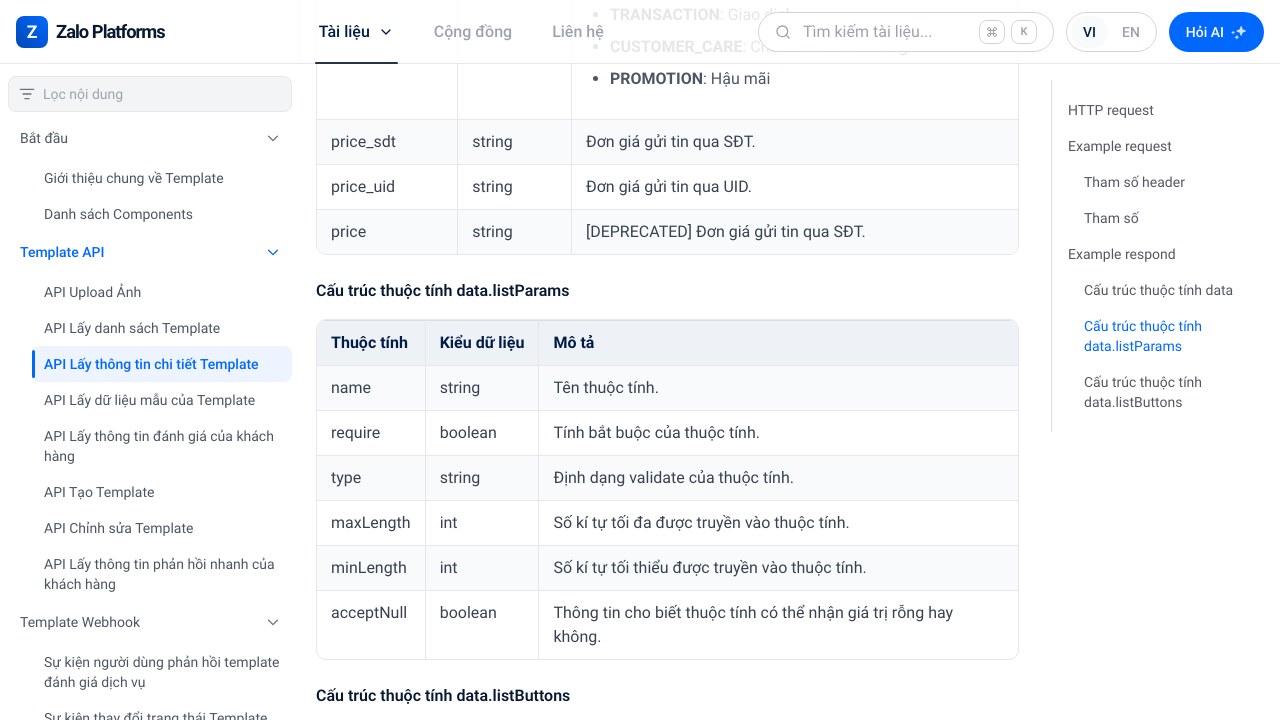
Screenshot of Zalo documentation, 23 October 2026. Source: Template details. Retrieve values for the actual approved template.
How does review rejection differ from a send error?
The template status event reports a rejected template with REJECT and a textual reason. That points to a review issue. The API error table instead identifies problems with a particular operation:
| Code | Meaning | First check |
|---|---|---|
| -124 | Invalid token | OA authorization and token |
| -131 | Template not approved | Template status |
| -1122 | Missing parameter | Required parameter names |
| -1124 | Invalid parameter format | Registered data type |
| -137 | ZBS charging failed | Balance and account setup |
| -144 | Phone-send daily quota exceeded | OA sending allowance |
Do not retry every failure with the same unchanged request. A practical incident record contains the error code, template ID and correlation identifier, with unnecessary customer data kept out of logs. For the sending request itself, see our Zalo OA API guide to sending by phone number.
How should the integration be operated after launch?
Track three separate events: template approval, request acceptance and delivery. The delivery-status API distinguishes a message accepted by Zalo's server from one delivered to a device. A successful HTTP response alone is therefore insufficient evidence for a delivered-message report.
Assign responsibility for template content, budget approval and technical incident handling. Keep a record of which template version an order workflow uses. When the template changes, check its parameter mapping before applying it to the entire customer flow. Our guide to authenticated Zalo OA webhooks in Node.js explains the event-receiving side of that connection.
Implementation note: The current template-create API documentation recommends creating and editing through ZBS Account while the API is being reviewed. This article checks documentation as of 23 October 2026; it does not claim a successful send from your business's OA.
Source portal: Zalo for Developers. Current detailed references are linked beside each claim. Accessed 23 October 2026.
Frequently asked questions
Does an approved ZNS template guarantee delivery?
No. Approval addresses the template content. Each request still depends on valid authorization, token, parameters and sending allowance. After acceptance, track delivery separately so that your report distinguishes a request received by Zalo from a message that has reached the recipient’s device.
Can one fixed price represent all ZNS templates?
That would be misleading. Template composition, CTAs and the phone or UID channel affect pricing. Inspect price_sdt, price_uid or the approved template in ZBS Account, record the date and confirm the tax treatment before turning the estimate into a budget.
Should a REJECT status be fixed in code or content?
Start with the template’s reason field. The reviewer may require changes to purpose, content or supporting information. If the template is already ENABLE but sending reports a missing or malformed parameter, investigate the application’s mapping and request values instead of resubmitting the same content.