IKEA and AR: the virtual fitting room for homes


Shoppers using a digital room planner inside a furniture showroom. Editorial illustration generated with AI.
Furniture shopping carries one constant worry: will this piece actually fit - and suit - my home? IKEA used AR to erase that worry, turning the phone into a virtual fitting room for rooms. It remains one of the smartest phygital plays in retail.
IKEA lets customers place true-to-scale 3D furniture models into their own room via the AR app before buying, alongside an online room planner, click & collect and an app tied to the store experience. The technology solves the exact fear - "will it fit my home?" - reducing returns and boosting purchase confidence. Three pieces: IKEA Place (2017, AR on ARKit), IKEA Kreativ (2022, AI room-scan and redesign), TaskRabbit (2017 acquisition, assembly service). The lesson: use technology to remove decision risk and connect online with the store.
What problem was IKEA actually solving?
Furniture is expensive, rarely repurchased and high-risk: customers fear buying something that will not fit the dimensions or match the style of their home. That barrier makes people hesitate - especially online. IKEA set out to erase it, not with discounts, but with certainty: let the customer see the exact piece in their exact room before spending a dong.

An IKEA store with its signature blue-and-yellow sign. Stock photo (CC0).
What are the three pieces of IKEA's phygital play?
IKEA Place (2017): an augmented-reality app that places true-to-scale 3D furniture into the customer's room through the phone camera. Launched the moment Apple opened ARKit, it made IKEA one of the first retailers to turn AR into a genuine sales tool rather than a stage demo. IKEA Kreativ (2022): a step further - scan the whole room with AI, erase the existing furniture from the photo, and redesign the entire space with IKEA pieces before buying. TaskRabbit (acquired 2017): solving the last pain of the flat-pack model - customers book assembly help at the moment of purchase. The digital experience completes itself with a physical service.

A shopping mall with experiential screens and lighting. Stock photo (CC0).
Why did it work?
Because the technology was never for show - it targeted the exact pain. Seeing the piece at home first gives customers the confidence to commit and cuts returns. The vast physical stores changed role rather than dying: from the place you must go to buy into the place you want to go to touch and try, while transactions flow increasingly through digital channels. Physical and digital reinforce each other - the definition of phygital, sitting at the top of the O2O → omnichannel → phygital maturity ladder. The same logic is now playing out in Vietnam with showrooms, model homes and clinics - and the pattern rhymes with Nike's phygital ecosystem, where the app and store feed each other the same way.
What can a Vietnamese business borrow?
The principle scales down far below an AR budget. In any industry with high buy-wrong risk - furniture, fashion, cosmetics - help customers visualize before committing: styled context photos, a room-matching consultation, simple mockups of the product in the customer's space. A furniture shop that asks "send us a photo of your corner" and returns a mockup has captured 80% of IKEA's insight at 1% of the cost. And the same risk-removal logic powers the conversational side too: an AI agent that answers sizing and compatibility questions instantly is the chat-channel version of the virtual fitting room.
Case study compiled from IKEA's public product launches (IKEA Place 2017, IKEA Kreativ 2022, TaskRabbit acquisition 2017) and retail industry coverage. Product capabilities evolve; verify current features on IKEA's official channels.
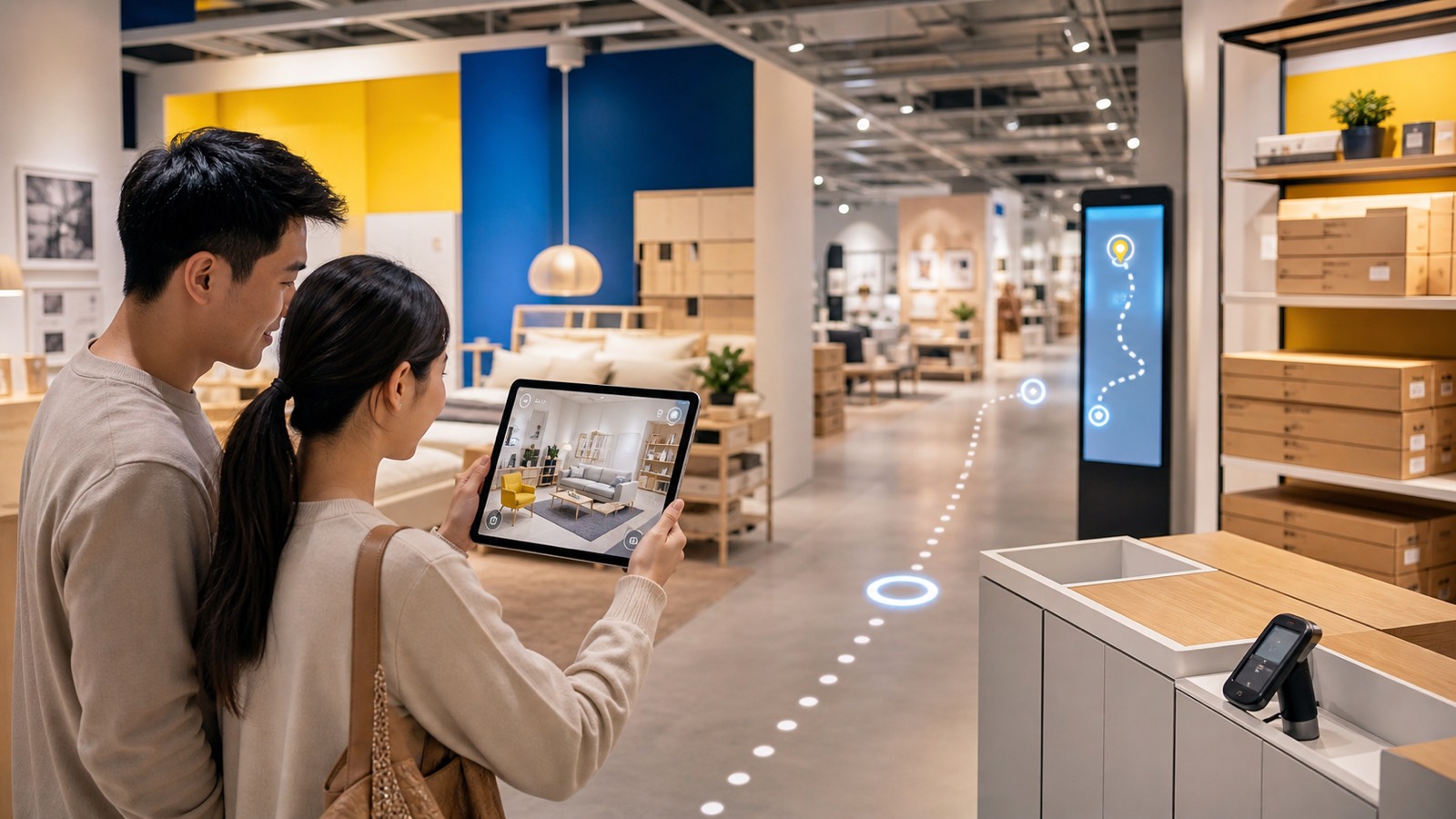
Customers preview furniture with AR in the showroom, then continue the buying journey digitally. Editorial illustration generated with AI.
Frequently asked questions
What is IKEA Place?
IKEA Place is the augmented-reality app IKEA launched in 2017 on Apple's ARKit platform. It lets shoppers place true-to-scale 3D models of furniture into their own room through the phone camera, checking size, proportion and color against their real space before buying. IKEA was one of the first retailers to turn AR into a genuine sales tool rather than a demo.
Why did IKEA's phygital strategy work?
Because the technology solved a real pain, not a show-off: furniture is expensive, rarely repurchased and high-risk - the fear of 'will it fit my home' stalls buyers. Seeing the piece in their own room gives customers confidence to commit and reduces returns. The huge physical stores stay as experience spaces while the digital layer handles convenience - physical and digital reinforcing each other.
What can a small business borrow from IKEA without an AR budget?
The principle, not the tech: in any industry with high buy-wrong risk - furniture, fashion, cosmetics - help customers visualize before committing. A set of styled context photos, a room-matching consultation, or simple mockups already lowers hesitation. The goal is removing decision risk; expensive AR is just one way to do it.