Katinat, Phê La, Cộng Cà Phê: three playbooks from Vietnam

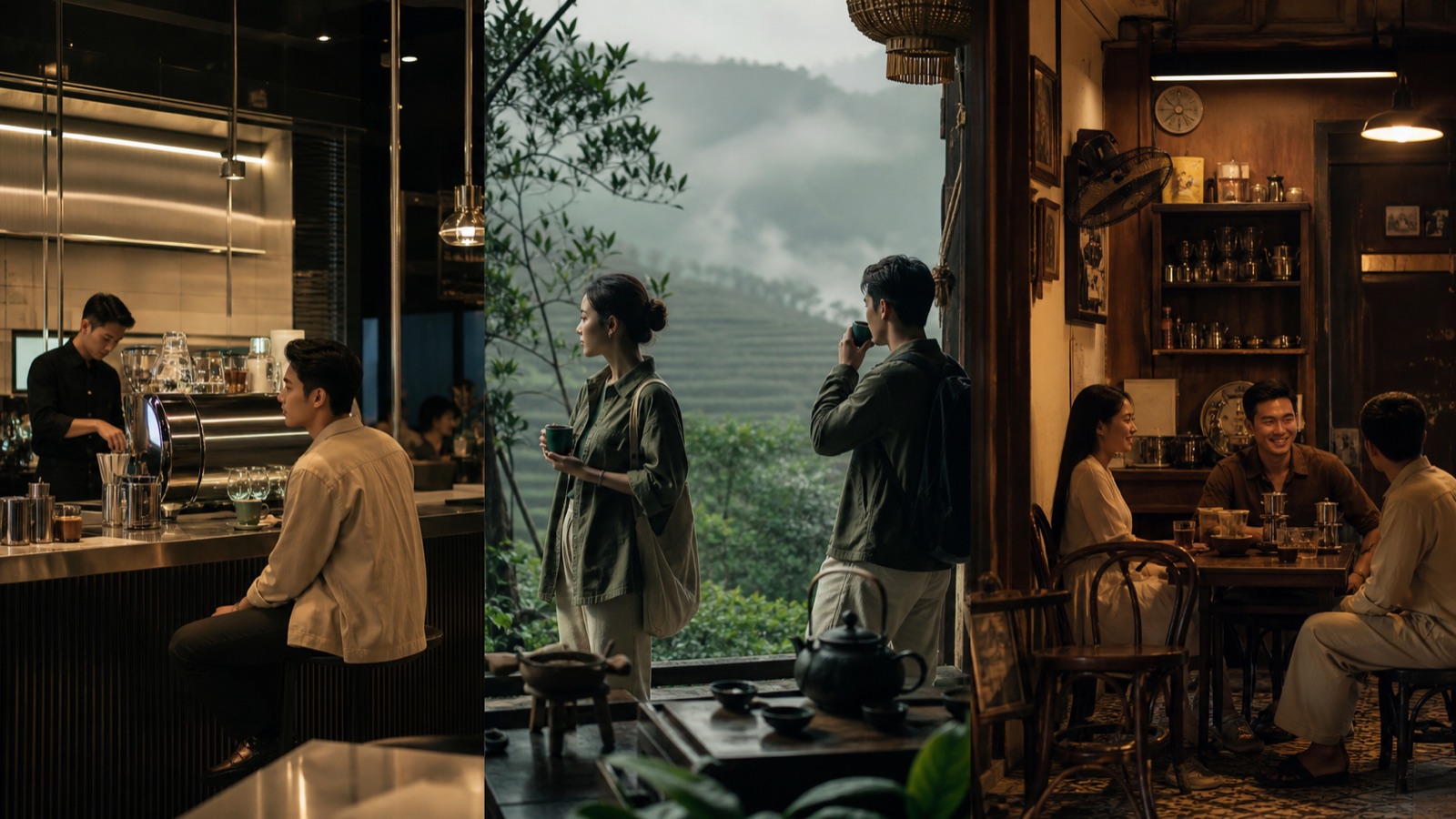
Three Vietnamese beverage worlds with distinct spatial identities. Editorial illustration generated with AI.
They all sell drinks, they all compete in one of Vietnam's most crowded markets - yet Katinat, Phê La and Cộng Cà Phê barely step on each other's toes. Each chain chose a completely different positioning axis - the cup, the tea leaf, and memory itself - and stayed ruthlessly loyal to it. For any small business hunting for its place in a crowded market, this is a three-in-one case study worth studying more than Starbucks.
Three chains, three positioning axes. Katinat positions on shareable product experience - the heat-reactive "rainbow cup" (late 2022), the sunlight-reactive Vườn Hạ cup - plus prime corner locations: roughly 65 branches by mid-2024, with one flagship store reportedly taking nearly 40 million VND a day. Phê La positions on ingredients: "We sell specialty oolong" from Dalat, the message "bold original flavor", camping-style interiors - from 1 store in March 2021 to about 35 stores and nearly 300 billion VND revenue in 2023. Cộng Cà Phê positions on culture: subsidy-era nostalgia since 2007, 60+ stores, franchised into South Korea and Malaysia. The shared lesson: choose one axis, say one message, stay consistent at every touchpoint.
Why are these three worth studying more than Starbucks?
Because they solve the exact problem a Vietnamese - or any emerging-market - small business faces: budgets are not unlimited, the market is packed with competitors, and young customers get bored fast. We covered the identity angle in our Jaguar rebrand case study and the loyalty angle with LEGO's turnaround; this piece looks one level up - at positioning strategy: before logos or colors, every brand must answer "what will people remember us for?". Katinat, Phê La and Cộng answered that question three different ways, and all three ways are reproducible.

The three brands differ in the world each owns in the customer's mind. Illustration generated with AI.
Katinat: when the cup does the marketing instead of the ad budget
In late 2022, the heat-reactive "rainbow cup" turned Katinat from a Saigon chain into a nationwide social-media phenomenon - and the instructive part is that it was not a one-off stroke of luck: the Vườn Hạ cup, which changes color in sunlight, repeated the formula. The underlying strategy: turn packaging - a cost every shop already pays - into a customer-operated media channel; every photogenic cup is a free post. The second leg is location: double-frontage corners on busy streets, where the flagship store (Đồng Khởi - Mạc Thị Bưởi) has reportedly taken nearly 40 million VND in a single day. Katinat also shows that a "national" brand needs social responsibility: its September 2024 campaign donating 1,000 VND per cup for flood relief served 888,696 cups - a transparently published figure of nearly 889 million VND.
Phê La: positioning on what's in the cup, not the cup itself
Phê La walked against the bubble-tea crowd with a stubborn self-introduction: "We sell specialty oolong." The entire brand revolves around hand-harvested, hand-processed Dalat oolong and the message "bold original flavor" - from TV spots to menus to camp-style interiors with folding chairs and canvas stools, a miniature Dalat in the middle of the city. The payoff of that focus: from its first Hanoi store in March 2021, Phê La reached about 35 stores, nearly 300 billion VND in revenue and an estimated 57 billion VND in after-tax profit in 2023. The lesson for small businesses: when you cannot win on reach, win on depth - one ingredient, one story, repeated until the market remembers.
Cộng Cà Phê: selling memory - and exporting it
Born in 2007 on Hanoi's Triệu Việt Vương street, Cộng chose the hardest but most durable axis: culture. Its subsidy-era nostalgia - enamel mugs, army blankets, aged wall paint - is kept consistent down to the smallest detail across more than 60 stores, including franchises. That consistency let Cộng do what almost no Vietnamese F&B chain has done: franchise abroad - into South Korea and Malaysia - where foreign customers pay for a slice of Vietnamese culture, not just a coffee. It is living proof of the argument in our brand guidelines for SMEs guide: a concept only becomes an asset when it is standardized well enough for someone else to run without diluting it.
What can any SME apply right away?
One, pick one axis and sacrifice the rest. Katinat does not chase "bold flavor", Phê La does not race on color-changing cups, Cộng does not need the most expensive corner - each wins on its own field. Two, design one photo-worthy touchpoint: a cup, a corner of the shop, a menu card - something customers spread for free; it is also the natural first step of the 7 phygital touchpoints of a coffee shop. Three, consistency is the multiplier: a positioning axis only builds equity when it repeats at every touchpoint - the space, the packaging, the fanpage voice, and even how the shop's profile appears when a customer asks AI "what's good near me" - the technical half we covered in Google Business Profile in the AI era.
Figures compiled from Vietnamese F&B trade press and analyses published 2023-2026 (iPOS, MarketingAI, CafeF, Tomorrow Marketers, Báo Đầu tư, Người Quan Sát), for reference at the time of writing; store counts and revenue change constantly. This is Chạm AI's independent analysis, not sponsored content for any brand.
A dedicated visual selected for this article. CC0 editorial photograph.
Frequently asked questions
How do Katinat, Phê La and Cộng Cà Phê differ in positioning?
Each chain picked a different positioning axis: Katinat built on shareable product experiences (color-changing cups) plus prime street-corner locations; Phê La positioned on ingredients - specialty Dalat oolong tea under the message "bold original flavor"; Cộng Cà Phê positioned on culture - a subsidy-era nostalgia concept distinctive enough to franchise into South Korea and Malaysia. All three are absolutely consistent with their chosen axis at every touchpoint.
Why is Katinat's cup considered strategy rather than luck?
Because it repeats: after the heat-reactive "rainbow cup" went viral in late 2022, Katinat followed with the Vườn Hạ cup that changes color in sunlight. The brand deliberately turned packaging - a cost every shop already pays - into a media channel: every photogenic cup is a reason for customers to post. Combined with high-traffic corner locations, the shareable product becomes a self-running marketing machine.
What can a small business with a small budget borrow?
Three things that cost discipline, not money: pick one positioning axis and repeat it relentlessly (Phê La only talks about specialty oolong); design one photo-worthy touchpoint - a cup, a corner, packaging - so customers spread the word for free; and keep the concept consistent in every detail the way Cộng does, from the enamel mug to the wall paint. Position clearly first, expand later.