Store lighting and air: comfortable customers stay longer

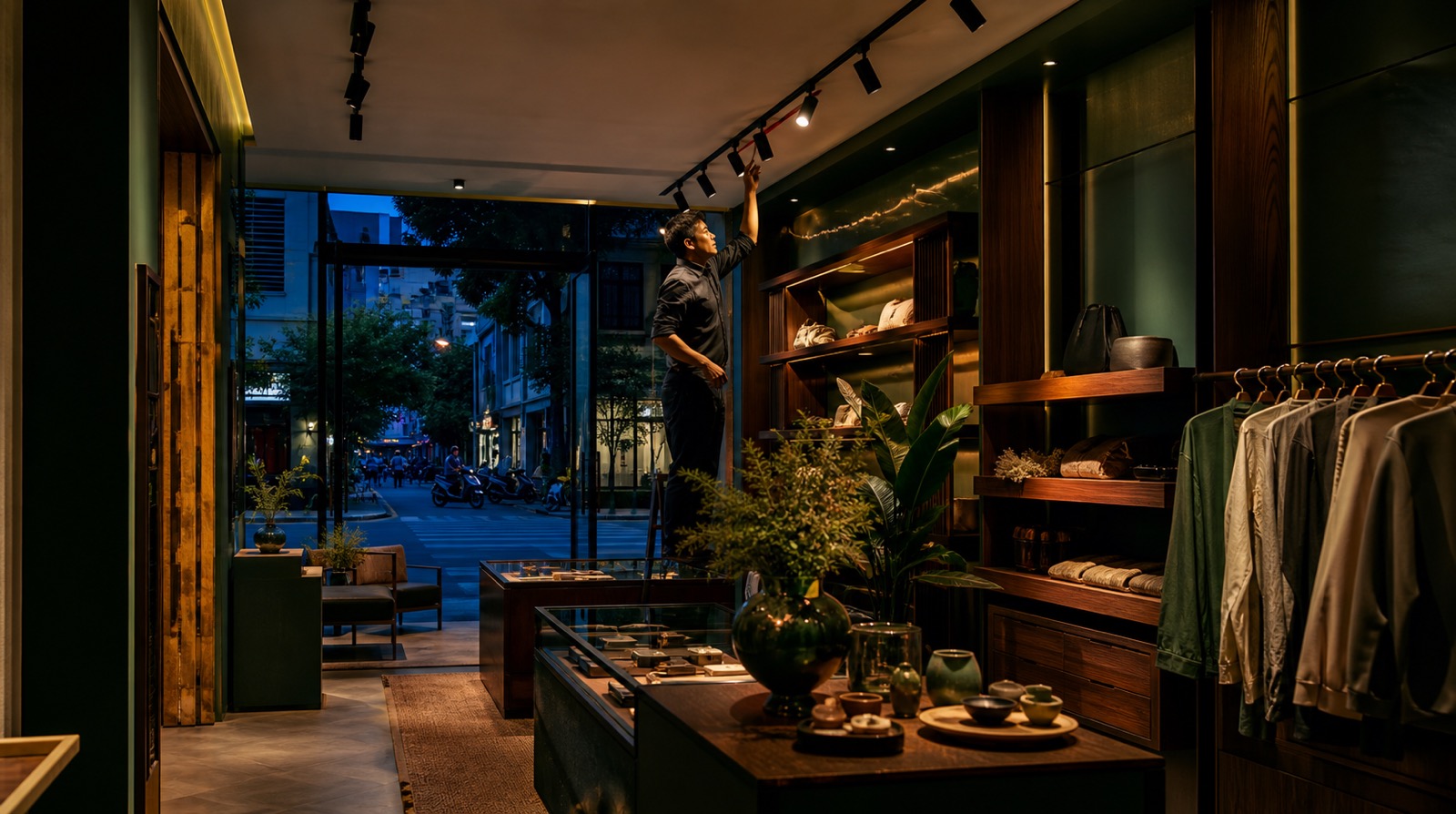
Store atmosphere comes from balancing ambient light, accents and the customer path. Illustration generated with AI.
Chart: reference colour temperature ranges by trade, from warm 2700K to cool above 5000K.
Our previous article covered floor layout: the entrance, the checkout counter, the walking route. This one goes into the second layer, the one eyes rarely notice but the customer's body registers clearly: light, air, scent, plants and noise. Customers almost never mention it. They simply stay longer, or leave earlier.
Quick summary: Lighting and microclimate drive most of how comfortable a store feels, and comfort converts to money: retail measurement data suggests a 1 percent increase in dwell time brings roughly a 1.3 percent increase in spending. Pick colour temperature by trade: 2700K to 3000K for cafes and furniture, 3500K to 4000K for fashion, 5000K and above only for supermarkets. Avoid glare and dead dark corners, keep CO2 below 1000 ppm, hold 24 to 26 degrees Celsius, use real plants and music you can talk over. The feng shui principles about yang energy and air flow, read this way, are all verifiable with metrics.
Why do light and air decide how long customers stay?
A physical store's revenue tracks one variable very closely: how long customers stay. In-store behaviour research by Path Intelligence, cited by retail lighting specialists in 2020, estimates that a 1 percent increase in dwell time brings roughly a 1.3 percent increase in spending. And dwell time is most sensitive to the things the body feels: brightness, light colour, temperature, scent and noise.
Lighting has direct evidence. In a field study by lighting manufacturer Zumtobel at the German fashion chain Gerry Weber, published in 2015, the store fitted with 3000K LED lighting tuned to its target customer group achieved roughly 10 percent higher sales than a comparable reference store, with average transaction value rising by a similar amount. Same products, same prices, only the light changed.
Feng shui names this layer in a different language: light is yang energy, circulating air is prosperity. Our reading, as laid out in the article on shop feng shui covering the entrance, checkout counter and circulation, is to keep the principle and translate it into a measurable mechanism: a well-lit spot is where the eye goes, and a well-aired room is one the body does not have to endure. You do not need to believe in luck to use every bit of the practical advice.
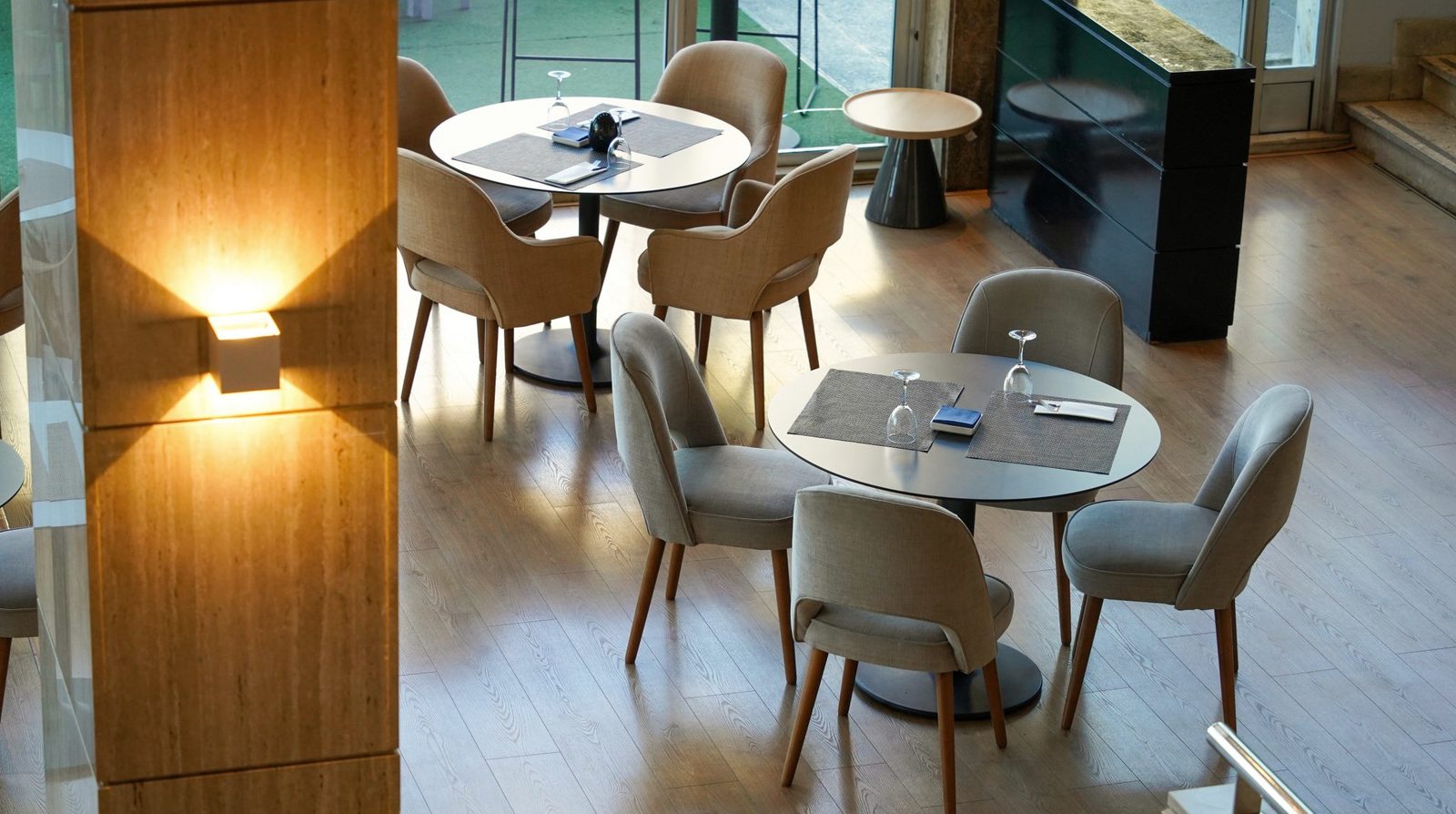
Warm golden light sets a relaxed mood for the shop. Stock photo (CC0).
How do you choose colour temperature by trade?
Colour temperature, measured in Kelvin, decides whether a space reads warm or cold. The most common mistake we find on site surveys is one lamp type for the whole store, usually cool white because it looks bright. The result is a cafe lit like a clinic, and customers who cannot explain why they do not feel like staying.
- Cafes, restaurants, bars: 2700K to 3000K. Warm light signals the body to relax, right for places customers come to sit. It is also the range where skin tones and food look their best.
- Furniture, spas, wood showrooms: around 3000K. Warm yet honest enough for customers to picture the product at home.
- Fashion: 3500K to 4000K. Neutral so fabric colours do not turn yellow. Fitting rooms should be 4000K with a colour rendering index of CRI 90 or higher, because the skin tone in the mirror decides the purchase.
- Jewellery, cosmetics, checkout: 4000K. Zones that need true detail and accurate colour.
- 5000K and above: cold, alert, industrial. Right for supermarkets and equipment stores, wrong for spaces meant to hold people.
On intensity, a common retail reference is around 300 lux for the general background and 750 to 1000 lux on key displays. The ratio matters more than the absolute number: accents should be 2 to 3 times brighter than the background so the eye is pulled to the hero products by itself. Warm light for seating and neutral light at the counter suits digitally layered coffee shops especially well, a model we cover in phygital for coffee shops.
Avoiding glare and dead dark corners
The two lighting mistakes that annoy customers fastest sit at opposite extremes. The first is glare: a ceiling bulb hitting the eye when a customer looks up, spotlights firing at eye level, or glass and mirrors reflecting a light source. The body answers glare by turning away, and customers avoid lingering in that zone without being able to name the reason. Fix it with deep-baffle or diffused fittings, beam angles of about 30 to 36 degrees aimed down at merchandise rather than sideways, and a reflection check from every spot customers usually stand.
The second is the dead dark corner. In feng shui, a dark corner is where energy stagnates; in retail data, it is a zone effectively cut from the journey: customers do not enter it, and products placed there sell noticeably slower. Zone lighting research compiled by Sigma Group in 2020 recorded that adding deliberate accent colour lighting to an area lifted footfall to that area by about 15 percent. The cheapest way to find dead corners is to look with a camera instead of your memory: photograph the store in the evening, pull the exposure down, and the areas that vanish first are the corners that need light.
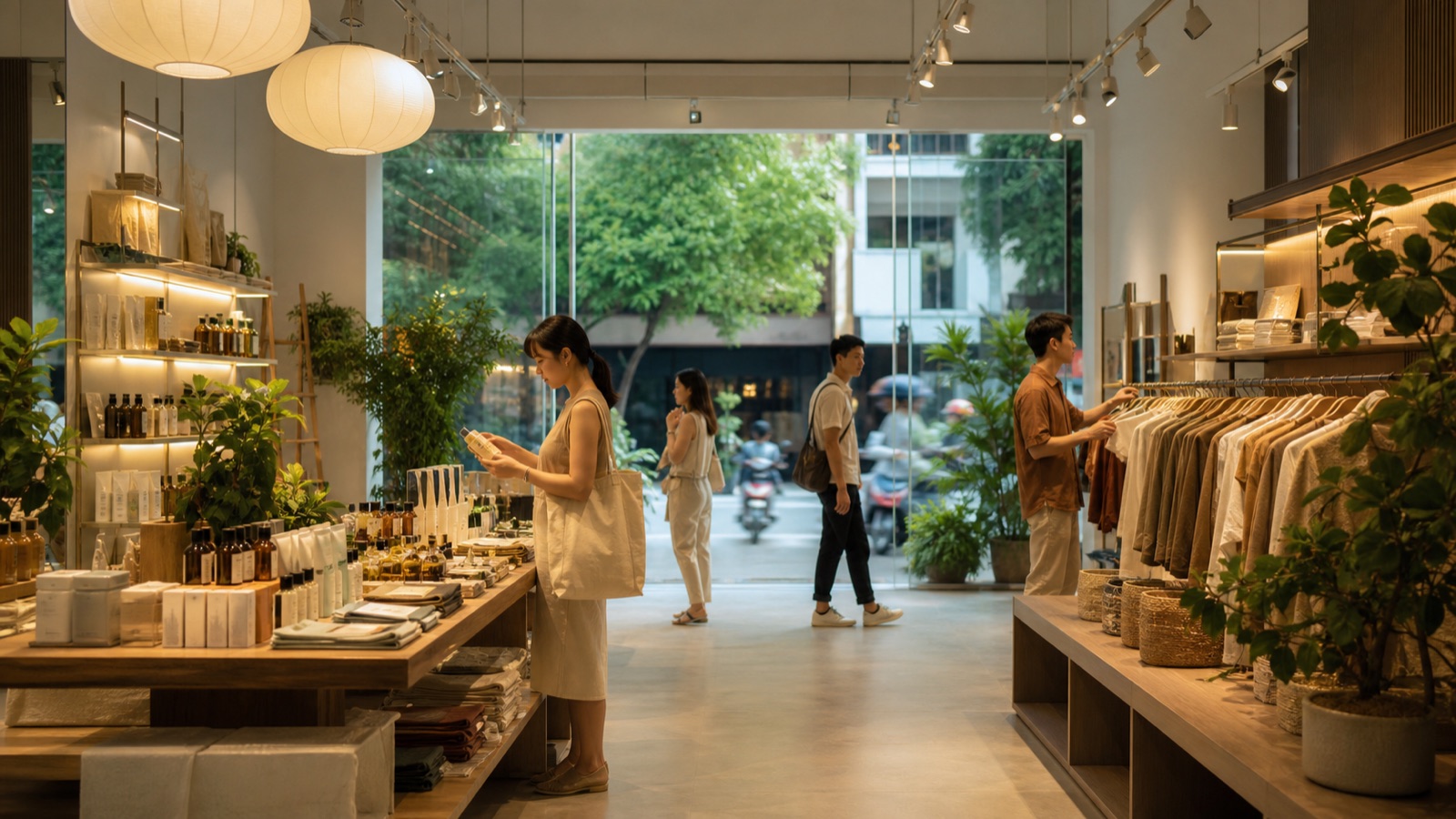
A dedicated visual selected for this article. Editorial illustration generated with AI.
Ventilation and scent: re-reading air flow is prosperity
Feng shui treats circulating air as a condition of prosperity. The scientific part of that sentence lives in CO2 concentration and smell. A study by Joseph Allen's group at Harvard University published in 2016 found that cognitive test scores of people in a room fell by about 15 percent at 950 ppm of CO2 and by up to 50 percent at 1400 ppm, compared with a 600 ppm baseline. A busy store sealed shut with the air conditioning running passes 1000 ppm very quickly. Customers in that air feel heavy-headed and foggy, and the natural reflex is to step outside, which means stepping out of your store.
Three concrete things worth doing now:
- Buy a CO2 monitor for the price of a few coffees, and place it mid-store. Below 800 ppm is good; above 1000 ppm means adding fresh air with an extractor fan, a vent, or a door opened on a schedule.
- Hold 24 to 26 degrees Celsius and 50 to 65 percent humidity. Chilling below 22 degrees to impress people only sends lightly dressed customers out earlier.
- Manage scent in order: remove first, add later. Damp, stale food and washroom smells must be fixed at the source with ventilation and cleaning. Only on a clean base does a light, consistent signature scent build recognition; spraying fragrance over a bad smell reads worse than no scent at all.
Plants and noise: the two forgotten factors
Real plants do three jobs at once: they give the walking route a soft visual anchor, cover raw wall surfaces, and absorb echo in rooms full of glass and tile. Feng shui placing plants in the balancing group has an observable basis. Selection rules: shade-tolerant indoor species, large leaves that are easy to wipe, positioned at resting points and at the end of sightlines, never blocking the main aisle or the threshold. A dusty artificial plant does the opposite job; customers read it as a signal of neglect.
Noise is the remaining comfort variable. A sensible background level for stores and cafes is about 55 to 65 dB, meaning two people a metre apart can chat without raising their voices. Music louder than that ruins the advice-giving that is a physical store's biggest advantage over buying online. High ceilings, tiled floors and glass walls add up to echo; fabric curtains, rugs, plants and an acoustic panel behind the counter are the cheapest fixes.
A 30-minute self-check for your store
- Stand at the door and look in: is there any zone clearly darker than the rest? That is a dead corner needing light.
- Look up from the three spots customers stand most: does any bulb hit your eyes directly?
- Check the skin on your hand under the fitting room or mirror light: a pale, greenish cast means the wrong colour temperature or a CRI below 80.
- Step in from outside and take one breath: what is the first smell? New customers smell exactly that.
- Read the CO2 monitor at the busiest hour: above 1000 ppm means ventilation is not keeping up.
- Take a phone call mid-store: having to raise your voice means the music or the echo is too much.
After adjusting, measure with the same metric set as the layout article: dwell time, depth of travel, average order value. Light and microclimate act most strongly on dwell time, so that is the first number to watch, two weeks before and two weeks after the change, at the same hours. The full measurement frame and how to attach a digital layer to the space sit in retail space design in the AI era.
If you would like someone to survey your lighting and microclimate on site, then adjust and re-measure with you, see the space and phygital service packages at Chạm AI or read the professional profile on the Đoàn Vi page.
FAQ - Frequently asked questions
What colour temperature should a cafe use?
A reference range of 2700K to 3000K works for seating areas, creating the warm, relaxed feel that makes customers linger. The barista counter and checkout can go up to 3500K or 4000K so staff see their work clearly. Keep contrast: display areas should be 2 to 3 times brighter than the general background so the eye finds them on its own.
What does light is yang energy mean in practice?
In feng shui, a well-lit place is said to hold yang energy, meaning vitality. The measurable part of that sentence is: the human eye moves towards whatever is brighter than its surroundings, and customers hesitate to enter or linger in dark zones. A dark corner in a store is effectively removed from the shopping journey, so products placed there sell noticeably slower.
How do I know if my store is ventilated well enough?
The simplest check is a low-cost CO2 monitor: below 800 ppm is good, above 1000 ppm means you need more fresh air. A 2016 Harvard University study found cognitive test scores dropped about 15 percent at 950 ppm and up to 50 percent at 1400 ppm compared with 600 ppm. Beyond the numbers, if you step in from outside and smell damp or stale food, the air in the room is not circulating.