Rigging event LED screens: loads, truss and structural safety

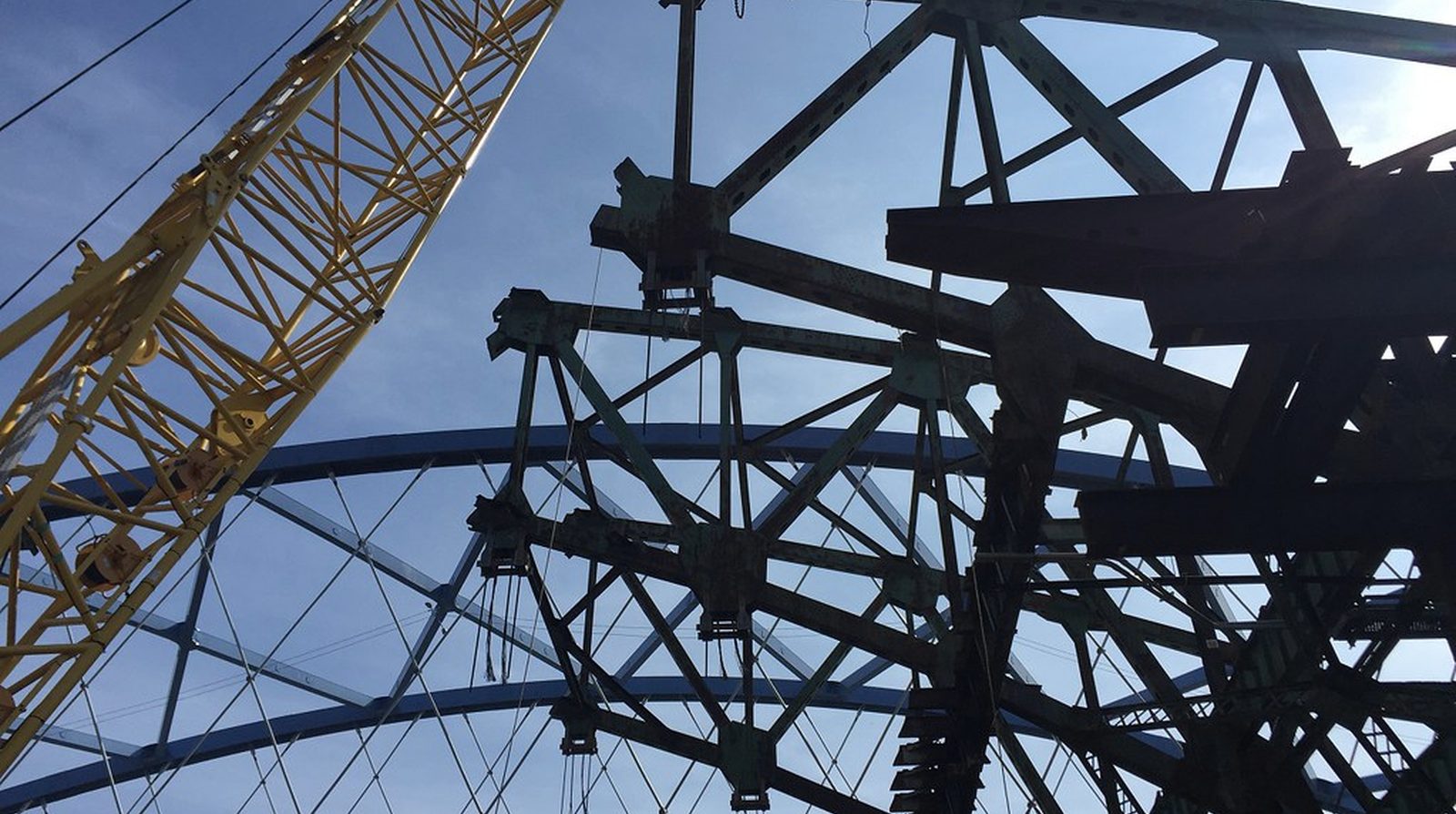
An 8 metre wide LED screen hanging above an audience is a load bearing assembly, not a decoration. Most disputes between event owners and contractors happen because nobody wrote the load figures down at the start.
Quick summary: Before flying an LED screen you need three numbers: the screen weight per square metre (reference range 25-40 kg/m² indoors, 40-70 kg/m² outdoors), the total rigged load including frame and accessories (typically 1.2 to 1.4 times the screen weight), and the allowable load at each anchor point in the venue. Truss is selected by span from the manufacturer load table, and adjacent pick points are usually kept within 2 to 2.5 metres. Hardware flown over people uses a safety factor of 8:1 to 10:1. Outdoor builds need a written wind speed threshold for stopping operation and a plan to lower the screen.
How much does an LED screen weigh per square metre?
Event rental LED cabinets today are mostly die-cast aluminium frames of 500x500mm or 500x1000mm. Reference weight ranges are 25-40 kg/m² for indoor screens and 40-70 kg/m² for outdoor screens, because outdoor housings are thicker, weather sealed and carry larger heat sinks. These ranges are only for budgeting and preliminary structural work. Before the rigging design is fixed you must obtain the datasheet for the exact cabinet model the contractor will deliver, because two P3 screens from different manufacturers can differ by 30% in weight. Pixel pitch does not determine mass, cabinet construction does.
That gives the first number. A screen of 8m by 4m is 32 m². At 32 kg/m² for an indoor cabinet, the display alone is roughly 1,020 kg. That is the static load of the display hardware only, before anything that holds it up.
Overhead truss rigging holds equipment above the stage, where structure decides safety. Stock photo (CC0).
What goes into the total rigged load?
The design load of the rigging system is not the same as the screen weight. Four more groups must be added: the truss or cabinet mounting frame, chain hoists and wire rope, the signal and power cabling running down the wall, and attached items such as wind covers, border lighting and logos. In real builds the total rigged load usually lands at 1.2 to 1.4 times the screen weight. For the 1,020 kg example above, the design load should be taken at around 1,300 to 1,400 kg.
That figure then has to be checked back against the venue capacity. Many arenas, convention centres and hotel ballrooms publish an allowable load per roof rigging point, usually stated as a maximum number of kilograms per point. If the venue has no such document, the default answer is that nothing may be flown from the roof, and the design has to move to vertical supports or a self standing ground support system.
Illustrative estimate built from the figures in this article. It does not replace an engineer's calculation for a specific design.
How do you select truss by span?
Event aluminium truss comes in two common families: triangular three chord truss for lighter loads and box four chord truss for heavier loads. Typical sections run from 300x300mm up through 400x400mm, 450x450mm and larger. Selection is not a matter of what looks solid, it comes from the load table published by the truss manufacturer: each truss type has a table stating how many kilograms of uniformly distributed load it carries at a given span, together with the resulting deflection. When the span doubles, load capacity drops sharply, far more than by half.
Three mistakes come up repeatedly on LED builds. First, applying the load table of a branded truss to locally fabricated truss with no material documentation. Second, hanging the screen at midspan when the table assumes uniformly distributed load, which makes the real bending moment much higher than assumed. Third, ignoring deflection: the truss may be far from failure yet sag enough that the top edge of the screen leaves vertical, bending the image and forcing the cabinet joints out of alignment.
How many anchor points and what safety factor?
The common working rule is to keep the distance between two adjacent pick points within 2 to 2.5 metres. An 8 metre wide screen therefore usually has 4 to 5 points, and a 10 metre screen needs 5 to 6. Each point must land on a truss node or on a transverse member designed to take load, never clamped at random onto a diagonal. In a multi row cabinet stack, the top row carries the full weight of everything below it, so the hanging bars and locks on that row must be the manufacturer's own parts, not equivalent substitutes.
On safety factors, the international live performance industry generally uses 5:1 for wire rope and chain hoists, tightened to 8:1 or 10:1 for rigging hardware above occupied areas. A shackle rated at a 1,000 kg breaking load should therefore be treated as good for only 100 to 125 kg when an audience stands below. Every separately attached item such as a small speaker, fixture or sign mounted on the screen frame also needs a secondary safety cable, so that nothing falls freely if the primary attachment releases.
Outdoor builds: how is wind load estimated?
An LED wall is a sealed surface, close to a sail. Dynamic wind pressure can be estimated with the basic physical relation q = 0.613 × V², with q in pascals and V in metres per second. At a wind speed of 15 m/s, roughly 54 km/h, q is about 138 Pa, which is around 14 kg of horizontal force per square metre of screen. On a 32 m² screen that is over 450 kg pushing sideways, before any shape or gust factor is applied. That force turns into an overturning moment at the base, so supports need ballast or ground anchors sized by a separate calculation.
Every outdoor design therefore needs a wind speed threshold for stopping operation written into the contract, along with who makes the call and how long it takes to lower the screen. Many contractors set the mark around Beaufort force 6, roughly 11 to 14 m/s, to stop operating and strip any wind catching covers. The exact figure is issued by the party responsible for the structure, based on install height, site conditions and support type.
Structural sign off checklist before showtime
Seven on site checks, completed at least 3 hours before the full rehearsal: 1) Compare the cabinet datasheet with the weight used in the calculation. 2) Count and photograph every anchor point, confirming each lands on a truss node. 3) Check secondary safety cables on every separately hung item. 4) Measure actual truss deflection at midspan and compare it with the predicted value. 5) Check ground support loading and levelling, and confirm the ballast count matches the calculation. 6) Run the hoists up and down once with the screen fully loaded. 7) Sign a handover record naming the person responsible for the structure, including the wind stop threshold for outdoor builds.
This checklist belongs with the overall production logistics rather than in a separate document, so it is worth folding into the corporate event planning checklist and keeping it on the same timeline. When dealing with contractors, ask for the load figures before discussing price, because LED screen rental pricing by square metre rarely reflects the frame and rigging that comes with it. For shows with several flown elements at once, a single coordinator inside a full service event production package keeps structural responsibility in one place instead of splitting it across three suppliers.
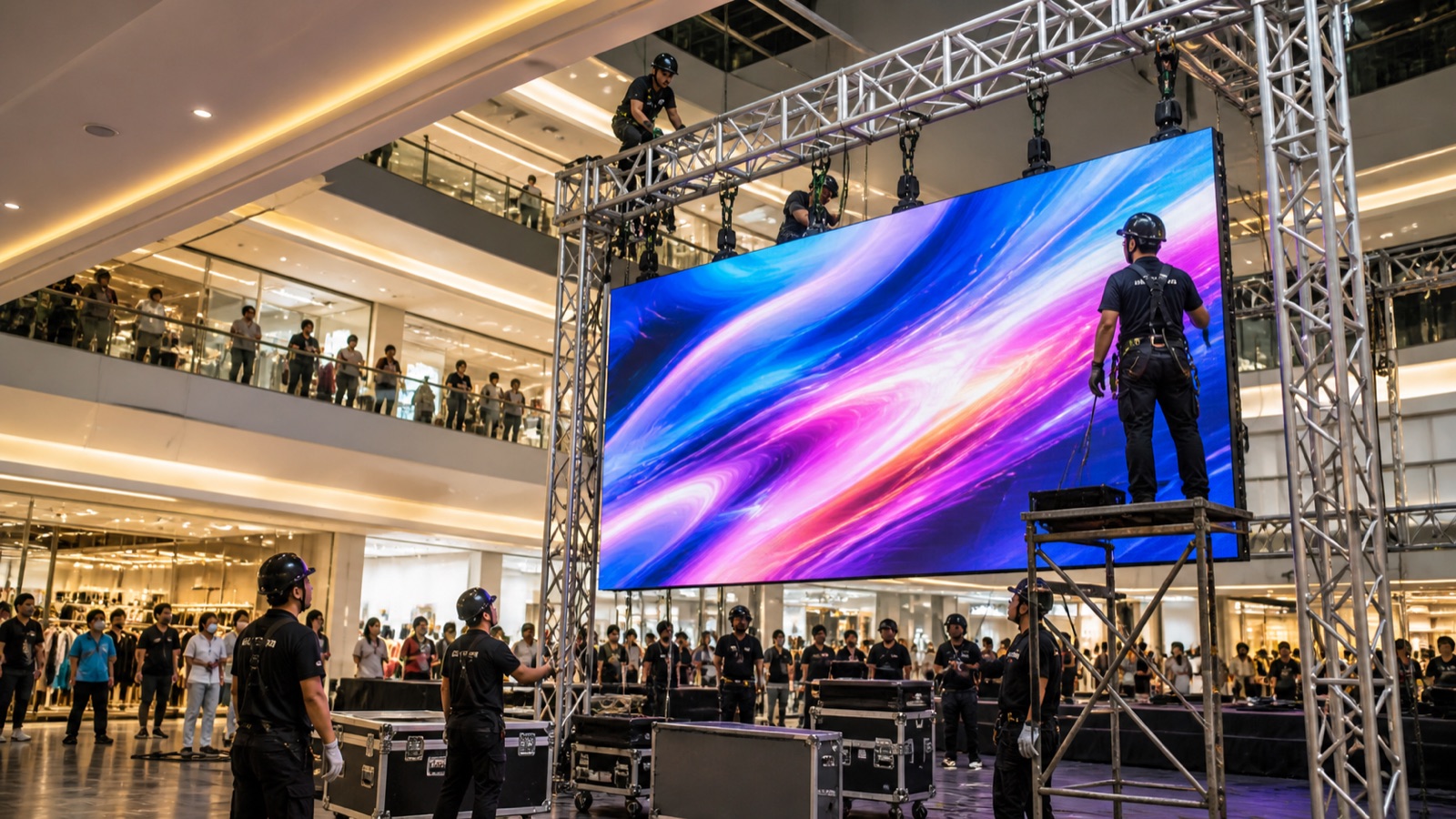
A dedicated visual selected for this article. Editorial illustration generated with AI.
FAQ - Frequently asked questions
How much does an event LED screen weigh per square metre?
As an approximate reference, die-cast aluminium cabinets used in event rental run about 25-40 kg/m² indoors and 40-70 kg/m² outdoors, where the housing is thicker and weather sealed. The exact figure depends on the cabinet model and must come from the datasheet of the units actually being delivered, not from pixel pitch.
How many anchor points does an LED screen need?
A common working rule is to keep the distance between two adjacent pick points within 2 to 2.5 metres, so an 8 metre wide screen usually needs 4 to 5 points. The final count must match the truss manufacturer load table and the allowable load of the roof structure or ground support at the venue.
What safety factor applies to equipment flown over people?
International live performance practice uses a 5:1 factor for wire rope and chain hoists, tightened to 8:1 or 10:1 for rigging hardware above areas occupied by people. In other words the allowable working load is only one fifth to one tenth of the breaking load printed on the hardware.